



There is a statement that at first sounds like a metaphor, almost poetic, yet becomes strikingly literal when one looks closely at the realities of education: thinking alongside a thinking person can save the world. It may seem exaggerated until we begin to notice the difference between what is commonly understood as “thinking” and what it actually means to think. In school contexts, thinking is often reduced to surface-level reflection, the repetition of familiar patterns, or the recognition of a correct answer that already exists somewhere outside the learner. Thinking, in a deeper sense, involves holding questions open, allowing doubt, forming new connections between ideas, and experiencing understanding as an inner act of freedom.
For this reason, thinking cannot be taught as a technique or mastered through a set of strategies. It is not transmitted through instructions or secured by assessment alone. Thinking emerges in the presence of another thinking person, someone who does not rush to provide answers, who is able to tolerate uncertainty, and who demonstrates through their own practice that not knowing is not a weakness but a necessary condition for intellectual growth. In such shared presence, within a living exchange, thinking begins to take shape.
Seen from this perspective, school is not merely a place where knowledge is delivered. It is a space in which thinking should be allowed to emerge. The model of knowledge as conversation offers an alternative to reproductive pedagogy, where the teacher possesses knowledge and the student reproduces it. In a conversational model, knowledge does not belong to any single participant. It arises between people, in dialogue, through the encounter of different viewpoints and the friction of genuine questions.
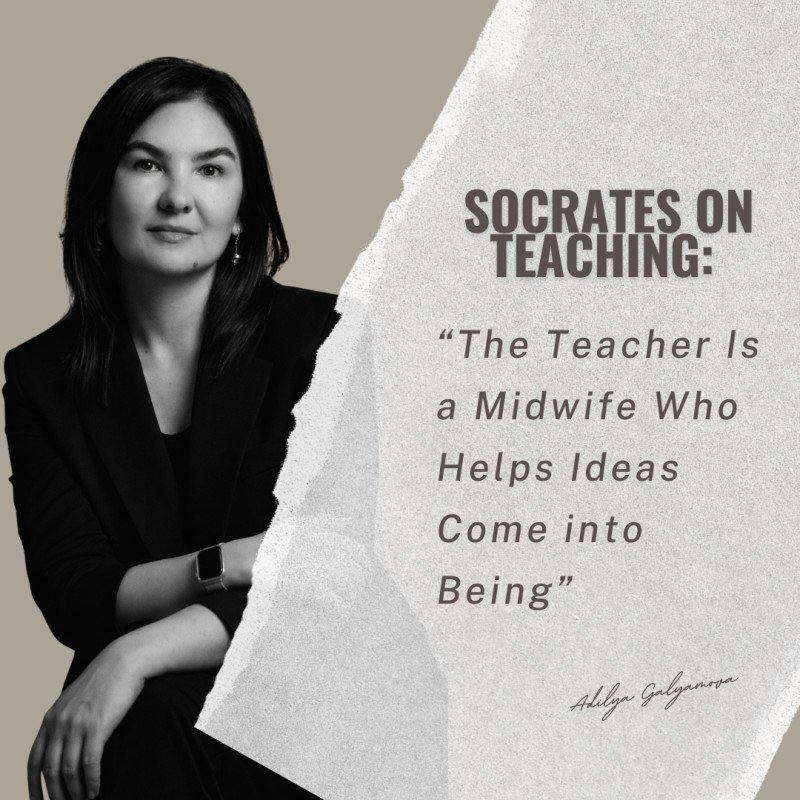
From its very beginnings, philosophy has insisted on this dialogical nature of truth. Truth does not reveal itself in silence or in monologue, but in conversation. Socrates did not establish schools or deliver lectures. He asked questions. His method, known as maieutics, was based on the belief that knowledge must be recalled, that it is born within the learner through doubt and dialogue. He described the teacher as a midwife who helps ideas come into being. Teaching through dialogue, including practices such as Socratic seminars, continues this tradition.
Such approaches matter because they allow students to encounter multiple perspectives and to recognize the complexity of meaning. In moments of genuine dialogue, school ceases to be a place of ready-made answers and becomes a place where thinking itself is formed alongside those who are willing to think.